
Culture After the Middle
AI is scaling the defensible, recognisable, cowardly middle the industry had already built.

Let’s skip the robot-apocalypse foreplay.
Believe it or not, the interesting thing about AI and culture is not whether a model can write a passable scene, generate a passable image, fake a passable campaign idea, or produce a passable treatment for a streaming thriller about a woman with secrets.
Of course it can.
We should actually be talking about the frightening amount of work the culture industry has done in the last twenty years trying to become passable. AI did not arrive in a healthy cultural system and start poisoning the well. The industry had already learned to confuse recognisability with proof, engagement with meaning, and prior evidence with judgement. The machine did not invent cultural cowardice, it simply found the workflow.
Let me be precise about the word “middle”.
I do not mean middlebrow. I do not mean popular. I do not mean commercial, studio, family or franchise entertainment, or the normal human desire to watch something with dinosaurs, witches, detectives, superheroes, drag queens, ghosts, rich mothers, or emotionally withholding men with expensive haircuts.
Popular culture is often where culture is most alive. The middle I mean is different.
The middle is culture pre-flattened by institutional caution. Work made to survive the meeting. Work with a clear audience segment, an obvious comp, a recognisable asset, a deck-friendly rationale, a measurable hook, and just enough aesthetic polish to disguise the fact that no one involved had to risk being wrong.
It is not bad because it is accessible (that is quite literally the point). Where things have gone awry is that it has been built to be defensible before it has been built to be felt.
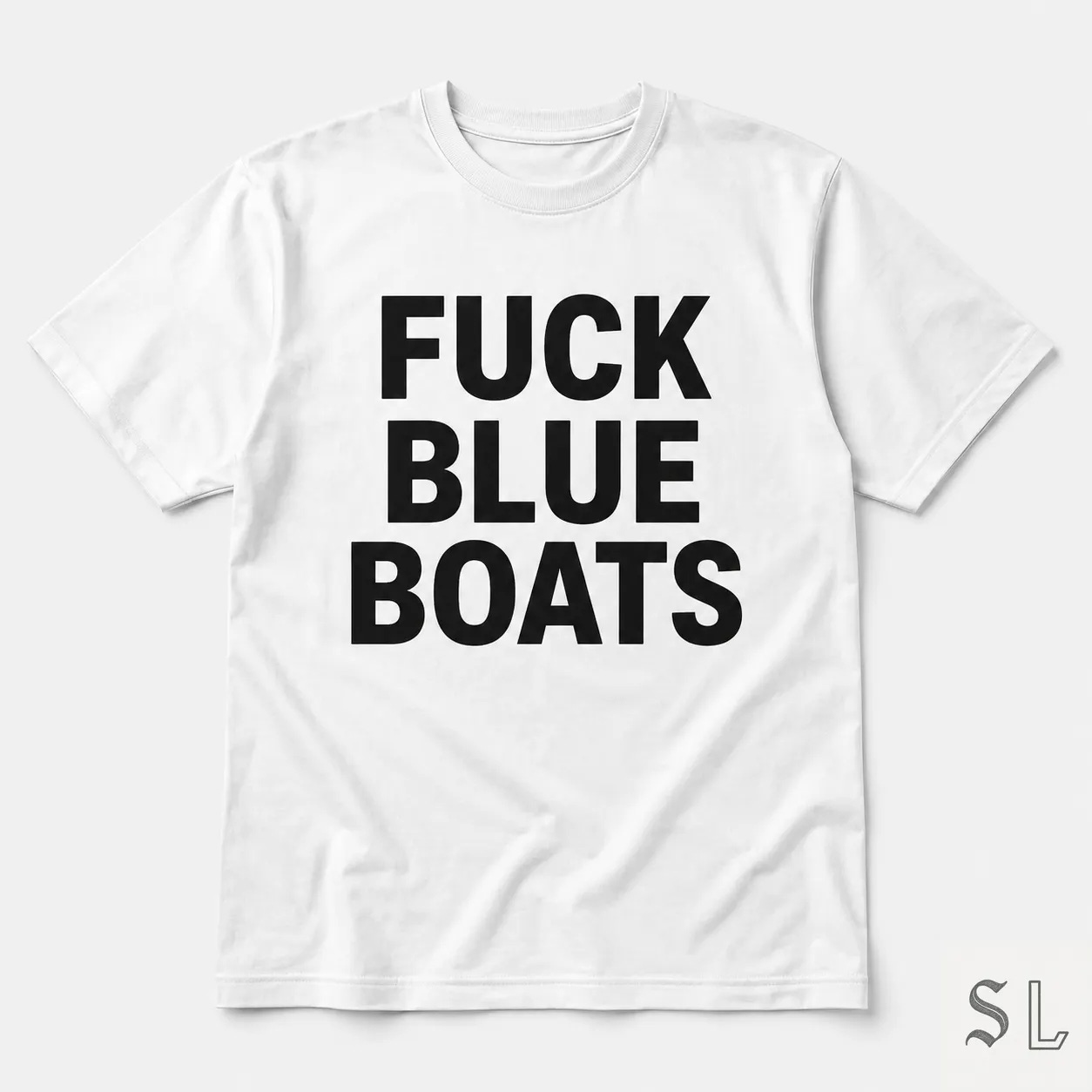
This is the Blue Boat problem for culture.
You’ll remember the Blue Boat from my Cannes piece, written while the industry chanted de-risk like a prayer. (The logic is the art fair, not the multiplex. Decide to become a commercial painter. Go to art fairs and study what sells. Notice that blue performs, boats sell, mid-size canvases have liquidity. Then paint a Blue Boat. Not taste. The averaged residue of other people’s conviction.)
Somewhere, a signal says the Blue Boat performed well. The Blue Boat tested. The Blue Boat engaged. So the system learns a lesson, which is not “people liked that thing in that context for reasons we should understand”. The lesson becomes: more Blue Boat.
Soon every pitch has a Blue Boat. Every poster has Blue Boat energy. Every script contains a structurally important Blue Boat with sequel potential and a TikTok sound strategy. The proxy hardens into doctrine. The signal becomes the product. The culture industry calls this de-risking. Then it acts shocked when the output becomes easier to imitate than to remember.
The obvious objection is that people choose the Blue Boat. They do; nobody is forced to watch. But “the audience wanted it” is where the industry stops thinking, not where it should start. Feed people nothing but variations on the Blue Boat and their taste for Blue Boats becomes the only data anyone has: a preference the system trained, then cites back as proof. (This, as you might imagine, is a contemporary strange loop.)
Hollywood is the cleanest crime scene because the money makes the fear visible.
The last decade of entertainment has been sold to us as abundance: more platforms, more shows, more universes, more extensions, more stories than any human being could watch without medically supervised unemployment. Underneath that abundance sits a much uglier scarcity: scarcity of nerve, scarcity of authorship, scarcity of cultural attachment, scarcity of people willing to say this is the thing without a number to hide behind. We made a hundred thousand hours of it so that no one would ever have to stand behind a single one.
Recognisable IP became the anxiety blanket.
The sequel, the remake, the prequel, the revived brand world. Not because those things cannot be good. They can be brilliant (and they sometimes are!). The tell is the reflex: reach for a title that already tested, so no one in the room has to defend a new idea, then bill the risk you dodged as “a bold reimagining”. Inherited worlds are not the enemy. The enemy is what happens when inheritance replaces conviction. (Does this ring a bell, Broadway?)
IP became a financing instrument, a marketing shortcut, a search term, a licensing bridge, a shareholder sedative, and a way for everyone in the room to be wrong together, on schedule. Someone has wanted this before. Therefore wanting has been proven. Therefore judgement can stand down.
Streaming made the surrender look scientific.
A title can now generate awareness, trend heat, completion, sampling, social clips, recap content, and dashboard happiness without troubling the culture for a second. It can be watched intensely and forgotten instantly. It can be a hit without becoming a ritual.
Awareness is not attachment. Completion is not memory. The clip is not the scene. The asset is not the work.
This is where AI enters.
Not as the villain in a cape, but as the unpaid intern of a system that already wrote the brief. An intern only executes. The brief was signed off long before any model touched it, by the same people now briefing against it in the trades. If the task is to generate a culturally plausible surface from existing patterns, AI is terrifyingly well qualified. It can make more middle at a speed and scale no human committee could ever match. It can produce the film-shaped object, the campaign-shaped object, the prestige-TV-shaped object.
None of this makes AI useless. It can be a tool of authorship. It can lower friction. It can help small teams build things that used to require institutional permission. It can extend the reach of people who already have taste, judgement, appetite and something to say.
But AI inside proxy culture is not liberation — it is the automation of the surrender already under way.
This is why the Hollywood labour fights mattered beyond labour.
The WGA did not simply argue about whether a machine could draft material, and SAG-AFTRA did not simply argue about whether a scanned body could be reused. Both were fights over whether human authorship and performance could be treated as extractable assets: sampled, simulated, recombined, and routed around.
That is the real nightmare. Not one bad AI movie. Not one synthetic trailer with too many fingers.
The nightmare is ownerless culture.
IP as a shell without a steward. Characters without pressure behind them. Worlds without a wound. Scripts without appetite. Performances without the risk of a body. A culture of endlessly recombinable parts, all recognisable, all monetisable, all legible, all dead. The perfect asset and the perfect corpse, it turns out, are the same object.
The defence against that is not nostalgia. Old Hollywood does not need a eulogy from me, and it certainly does not need absolution. Hollywood was enshittified before AI arrived. Consolidation, streaming economics, franchise dependency, development hell, labour compression and metric worship all did their work. The machine did not break the system. It arrived after the system had made itself breakable.
The defence is judgement.
Not “human creativity” in the greeting-card sense. Not the idea that people are magical because we have childhood memories and occasionally cry in airports (never happened). Judgement means the nerve to back a call before the proxy confirms it. To know what has force. To refuse the comp when the comp is lying. To know that “Succession meets Squid Game” is a spreadsheet, not a story. To understand the difference between a pattern and a pulse.
Taste is not a pattern match. Craft is not a prompt. Cultural attachment is not the same as engagement. And poetry, thank god, still has no business plan.
This is the barbell I keep railing on about.
On one end: infinite middle. Cheap, fluent, versioned, optimised, generated, localised, surfaced, A/B tested, politely alive for thirty-six hours, then gone.
On the other: work with authorship dense enough to resist averaging. Work with enough specificity that it could not have come from “what usually happens next”. Work with enough danger that someone had to choose it. Work that carries the pressure of an actual mind meeting an actual world, not just a system completing the nearest recognisable shape. The work that sticks tends to be the thing no committee would have greenlit with a straight face: an Everything Everywhere All at Once, a Fleabag.
The bar between those two weights is where the expensive average dies. Too costly to be disposable, too timid to be necessary.
Machines can generate. Congratulations to the machines.
The question is whether humans and institutions still know how to want something the data has not already approved.
AI did not invent the middle. Engagement culture did that. Proxy governance did that. Fear did that. The model only exposed the crime by making it scalable.
So the task is not to become anti-AI. That is too easy, and frankly too boring. The task is to stop making ourselves so available to imitation.
Protect the strange. Protect the specific. Protect the live wire of judgement. Protect the people in the room who can say, “No, not that,” before the data knows why. Protect the work that does not arrive pre-explained, pre-approved and pre-digested for the quarterly strategy off-site.
The future will not belong to people who can make more middle. Thankfully, the future belongs to the ones still strange enough, specific enough and brave enough to become harder to average.