
How Porn Became Hollywood's Secret R&D Lab
Survival of the Filthiest: The Protocols of Pleasure

Why You Really Bought the Machine
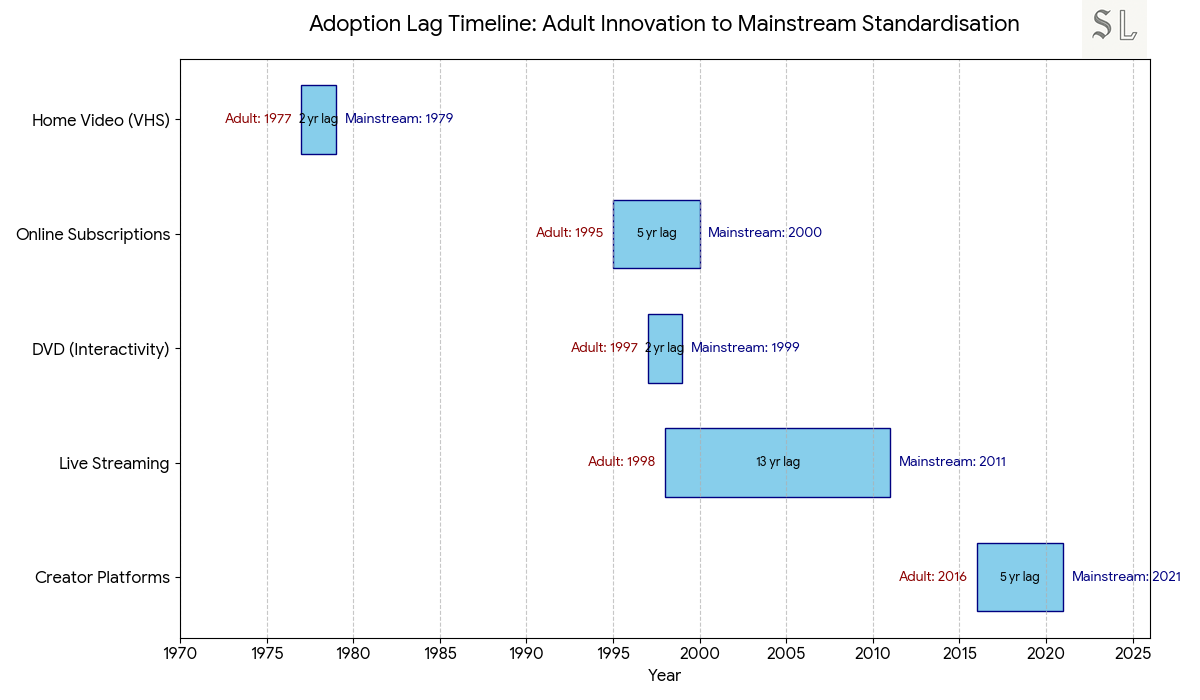
In 1977, Hollywood saw the VCR as a “piracy machine” and froze in legal terror. The San Fernando Valley saw it as a backdoor distribution workaround and shipped immediately. By 1979, while mainstream studios finally signed on, porn had already spent two years proving the business model (X-rated tapes accounted for over 50% of initial sales). You bought the hardware, but the margins provided the reason to turn it on.
Pornography didn’t necessarily invent the microchip, but it repeatedly pressure-tested how a format survives under extreme exclusion.
The Adult Sector: Survival of the Filthiest
Lacking VC safety nets or traditional banking relationships, it’s forced to solve the internet’s hardest problems (like getting a credit card to work in the dark) decades before a mainstream boardroom presentation on the Lot. It functions as a de facto laboratory for five dimensions:
Technology Adoption: Stress-testing new tech (VHS, DVD, streaming) earlier and at a massive scale.
Forced Innovation: Inventing subscriptions and micro-payments out of pure necessity.
Backdoor Logistics: Mastering direct-to-consumer and P2P routes when traditional channels are locked.
Interface UX: Perfecting scene navigation and interactive branching well before they hit the multiplex.
Creator-Operators: Decentralised performers owning their brand long before “influencer” was a buzzword.
Just Like Porn But with a Shower and a Suit
Fringe innovations become the global standard once the risk has been sanitised.
Netflix’s “Skip Intro”: A spiritual descendant of 1990s adult DVD menus. Customers wanted to skip the “plumber’s dialogue” and get straight to the action.
Twitch/TikTok Tipping: A re-skinned version of 1990s adult cam tokens used to monetise intimacy.
The Paywall: Danni’s Hard Drive was charging $15/month in 1995 while everyone else treated the web as a free brochure.
Real-Time Payments: Every e-commerce site uses the plumbing adult sites built to bypass high-risk stigma.
Affiliate Marketing: Industrialised in the late ‘90s by adult tracking tools like NATS.
Streaming Backbone: Global CDNs (like Akamai) were stress-tested by adult traffic long before Netflix was a glimmer in the eye.
Interactive Video: 1997 adult DVDs treated viewers as active participants with multi-camera angles and branching narratives.
Early Adopter in the Sheets
If the adult sector is Hollywood’s most reliable early adopter in the sheets, we ignore their current positions at our own peril. To see where the limelight is headed, watch how the margins are currently handling synthetic media, identity-gating, and de-platforming.
Mainstream “follow” is confirmed when these fringe innovations, once considered radical or illicit, become the standardised toolkit of global media giants.
Let’s begin.
Porn’s Hard Engineering and Constraint Stack
Porn is powered by a Constraint Stack: a set of barriers that demand immediate, functional workarounds:
Distribution Exclusion: Being barred from “respectable” broadcast and retail channels forces the industry to pioneer direct-to-consumer routes and private consumption formats.
Payment Stigma: Rejection by mainstream banks due to “high-risk” classification forced the development of specialist financial rails, real-time verification, and advanced anti-fraud measures.
Platform Bans: Exclusion from official app stores and social networks necessitates the mastery of first-party distribution and alternative discovery methods like SEO and decentralised networks.
Regulatory Pressure: Early exposure to strict age-gating and compliance laws makes identity assurance a core part of product design rather than an afterthought.
This pressure is combined with a high-frequency demand condition. The adult audience is vast and has a low tolerance for friction, which creates a ruthless environment for UX optimisation. If a payment button or a video player adds a second of delay, the unit economics collapse. In this arena, mechanics are the product.
San Fernando Valley: From Factory Cluster to Networked Lab
Historically (broadly 1970s-1990s), the San Fernando Valley went beyond a cluster of warehouses and acted as a "parallel Hollywood" with a much lower threshold for shame and a much higher tolerance for risk. While Hollywood proper was concerned with "cinematic integrity," the Valley's dense network of duplicators and mail-order moguls treated film like a commodity to be moved at any cost. This proximity to mainstream tools, but total exclusion from mainstream morals, enabled a shipping cadence that made the studio system look like it was running in slow motion.
However, the internet triggered a fundamental structural shift: disintermediation. The “lab” stopped being a specific place in California and became a global protocol. By the 2010s, the most significant adult platform operations had moved to Montreal and Europe. The factory was gone, replaced by a global network of independent creators and platform operators.
Case Study I: VHS Proving Size and Length Does Matter
The first major proof of the “R&D lab” thesis is the home video revolution. While Hollywood was litigating to keep movies in the cinema, the adult industry was building the infrastructure for the living room.
The Dated Peg: Adult titles were distributed on VHS as early as 1977. Mainstream studios, paralysed by piracy fears, did not follow with major releases until roughly 1978–79.
The Reality: While industry lore insists porn single-handedly murdered Sony’s format, the truth is more a case of “size matters”. VHS offered a thumping two hours of recording time at launch, ideal for a feature-length adult film, while Betamax’s measly one-hour limit meant the “action” would be cut short right when things were getting interesting. Sony didn’t necessarily “ban” porn, they just made it technically impossible to enjoy a full session without a tape change, while JVC’s open VHS ecosystem welcomed the SFV studios with open arms.
The Scale: In the first years of the VCR, adult titles reportedly made up more than 50% of all recorded tapes sold. This share only fell below 25% in the mid-1980s as Hollywood content finally flooded the market.
Case Study II: The 1-900 Toll Road and How Phone Sex Financed the Future
When the “free” broadcast channels were closed to adult content, the industry pioneered the logic of premium access, the same logic that now governs the modern streaming era.
Subscription TV and Hotel PPV: The Playboy Channel launched in 1983, pioneering the premium subscription cable model for niche content. Simultaneously, hotels began offering pay-per-view (PPV) adult films. Mainstream media followed years later, using the same models to sell sports and movie events once the infrastructure and consumer habits were proven.
1-900 Lines as Proto-Microtransactions: Between 1984 and 1985, erotic phone services exploded, monetising a new telecom feature long before mainstream contests or hotlines adopted the mechanic.
Infrastructure Financing: This was more than a subculture and acted as a financial engine. Adult phone lines reportedly financed telecom infrastructure growth in various regions, driving significant international call traffic.
When the “front door” of distribution is locked, adult entertainment builds a “toll road” that the rest of the media ecosystem eventually inherits.
Case Study III: Web Monetisation and the Pixel
In 1995, while mainstream media was treating the web as a digital brochure, the adult industry was already building a functional commerce engine. Because these businesses lacked the “safety net” of venture capital, they were forced to be profitable from the day they launched.
The Bandwidth Scale: In June 1995, Danni Ashe launched “Danni’s Hard Drive”, a subscription site charging $15 per month. Within a few years, it was reportedly earning $2.5 million annually and consuming more bandwidth than the whole of Central America.
Real-Time Verification: To survive, adult sites had to solve the problem of trust and fraud immediately. They pioneered real-time credit card verification systems to grant instant access to paying users. Specialist processors like iBill (1996) and CCBill (1998) emerged to handle “high-risk” transactions that mainstream banks refused to touch.
The Affiliate Origin Story: The industry developed the logic of performance marketing through sophisticated affiliate tracking software. Tools like NATS (Next-generation Affiliate Tracking Software), developed by Fabian Thylmann in the late 1990s, allowed a global network of webmasters to drive traffic in exchange for commissions.
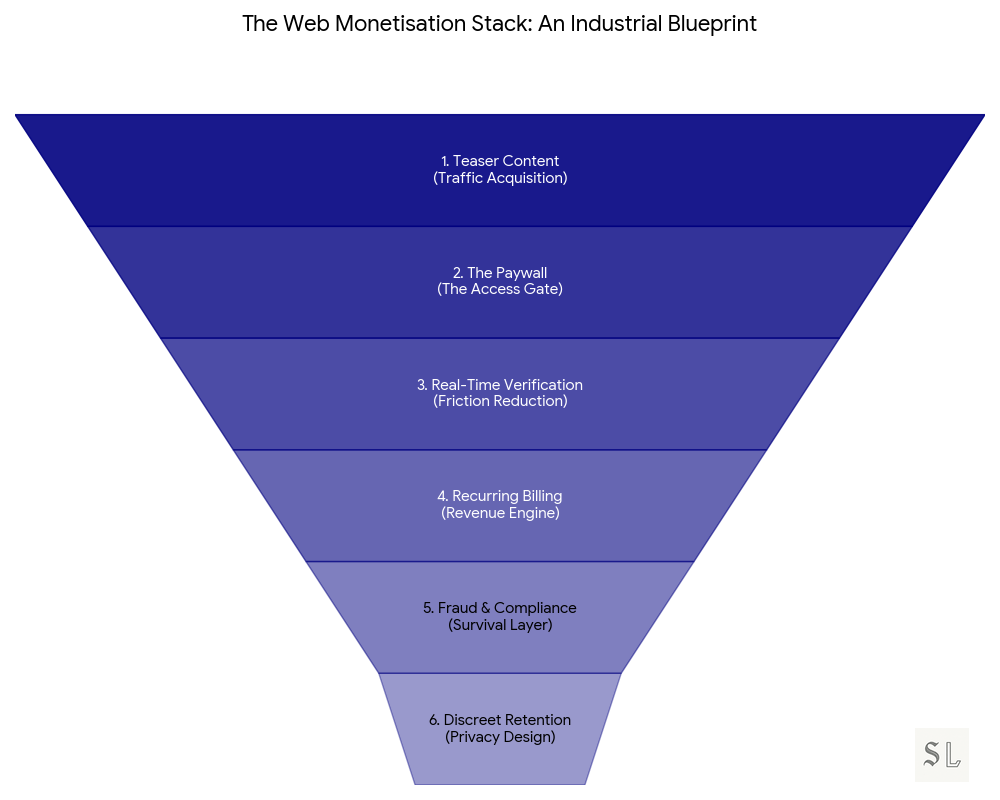
The web’s monetisation grammar (recurring billing, secure paywalls, and affiliate loops) was invented by adult e-commerce.
