

In Part 1, I laid out the four rules I use to read the future: exponentials, leverage points, path dependence, and the politics embedded in technology. Together, they explain why change arrives as thresholds, not cycles.
These next five predictions are less like separate trends and more like one system rearranging itself once AI becomes infrastructure. When Google can publicly say it went from 9.7 trillion tokens a month to 480 trillion, then 980 trillion a couple of months later, “traffic” stops meaning people and starts meaning machines. When roughly 60% of Google searches end without a click, the web stops being navigational and becomes extractive. Those two facts alone force everything downstream.
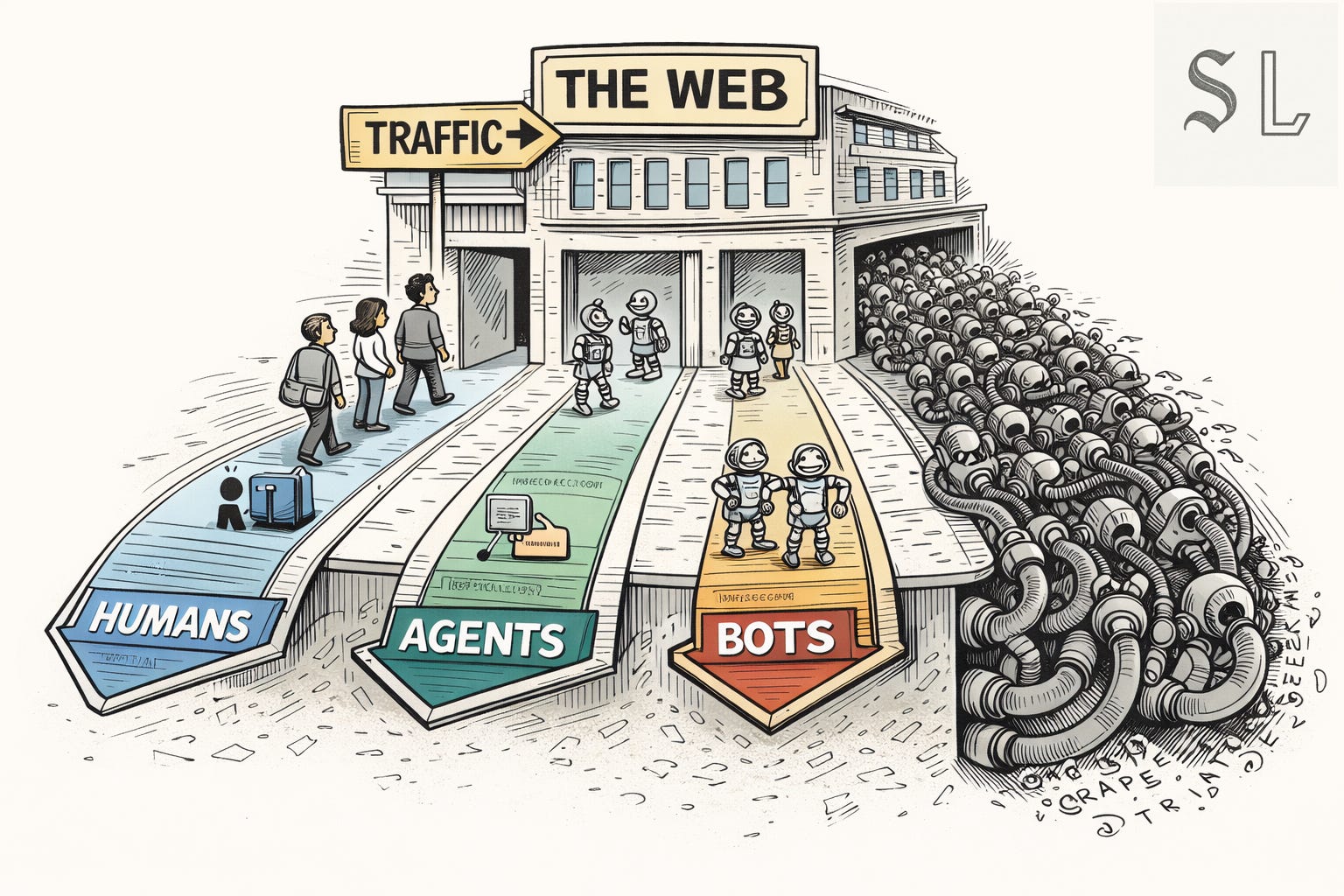
So the web splits into human / agent / bot lanes. Feeds stop being social and become theatre, so influence moves into private rooms and live spaces. Work reorganises around AI stacks, which deletes tasks and hollows out mid-layers. Tiny teams with serious stacks start beating bloated organisations on briefs. And as digital output races toward zero marginal cost, being there becomes the premium signal again.
Read individually, each prediction sounds plausible. Read together, they’re a single shift: where power moves when attention, labour, and authenticity stop behaving the way they used to.
This is the point where strategy stops being “do more, optimise harder” and becomes “pick your terrain”. Choose the platforms, defaults, and operating rules you’re building on now, because soon you won’t get a vote.
6. The web splits into human, agent, and bot lanes
What it is
For most of the web’s history, there was one implicit assumption: traffic = people. That assumption is now false.
The internet stops being a single surface and becomes three overlapping lanes, all touching the same content but operating by different rules:
The human lane: the web as we recognise it (sites, apps, feeds, paywalls, UI)
The agent lane: personal AIs that read, summarise, compare, and transact on your behalf
The bot lane: industrial crawlers and model pipelines ingesting content at scale to train, index, and generate more content
Same content, different users, different economics.
And here’s the uncomfortable part: humans are becoming the premium constituency. They’re smaller, pricier, harder to win, and easier to lose.
Why I think it
Because the web is already being rebuilt for machines, in public, in numbers.
Google has publicly disclosed token processing jumping from hundreds of trillions per month to nearly a quadrillion per month. That is not “more humans searching”. That is machines talking to machines at scale.
Zero-click is now normal. When most searches don’t produce a click, the web stops being navigational (“go read it”) and becomes extractive (“we’ll summarise it here”).
A parallel search ecosystem is forming for agents: short, structured snippets designed for machine retrieval, not human browsing. That’s a completely different optimisation target than SEO ever was.
Publishers are reacting rationally. If bots can read you for free, index you, train on you, and replace your pageview with a summary, your business model collapses. So the response is inevitable: metering, blocking, licensing, billing.
At scale, this is the shift: the web’s primary audience becomes machines, and humans become a premium segment.
What it will mean
The internet becomes explicit about what it already is and everyone has to pick a lane.
Human-facing surfaces get quieter, smaller, more curated, and more paywalled, because signal has to be protected from junk reach and free extraction.
Bot access becomes a priced input: contracts, rate limits, licensing, and “pay to crawl” logic as a normal operating line item.
Agent access becomes strategic distribution. If an agent can’t find you, compare you, or transact with you, you effectively don’t exist — even if humans “could” access you.
Authenticity becomes billable. Proof that something came from a specific human, verified source, or trusted institution becomes economically valuable, especially in news, finance, health, and culture.
If you don’t decide which lane you’re designing for, you’ll be strip-mined by the ones that did.
7. Companies reorganise around AI stacks, not departments
What it is
AI stops being a tool you “use” and becomes the operating layer of the firm.
The old model was departments built around functions: marketing, ops, strategy, finance.
The new model is everyone plugged into the same spine:
AI stack / data / workflows / human oversight
Humans don’t disappear but the job shifts from doing the work to running the work.
If you want the simplest translation: your organisation becomes a set of automated workflows with people supervising the exceptions.
Why I think it
Because the economics of white-collar work have already moved, and the signalling is no longer subtle.
Big firms are publicly pausing or cutting large numbers of back-office and mid-layer roles. These jobs exist largely to move information around: draft, summarise, format, reconcile, report. That’s exactly what agents do well.
Agent systems already handle a huge amount of “junior work”: research, first drafts, analysis, reporting. Not perfectly, but cheaply and fast enough that the cost equation changes.
The productivity gains show up when seniors act as editors and orchestrators, not when organisations bolt tools onto old processes and pretend the org chart is sacred.
Adoption has moved from “experiments” into day-to-day usage across multiple functions, but only a minority of companies have actually rebuilt workflows and governance around it. Those are the companies pulling away, because the gains compound.
Rather than mass unemployment, the nearer-term pattern is mass task deletion. Speaking of…
What it will mean
The org chart turns into a barbell:
fewer senior operators at the top (judgement, accountability, direction)
a thin coordination layer (workflow owners, programme leads, governance)
an automation bedrock underneath (agents doing the drafting, analysis, ops)
Concrete consequences:
“Works effectively with agents” becomes baseline corporate literacy, like being competent in Excel.
Entry-level roles shrink and mutate into AI-first apprenticeships: fewer people, higher expectations, more supervision and QC from day one.
Mid-career value shifts from execution to:
judgement
domain expertise
quality control
accountability
If your job exists to format, transfer, or lightly transform information, the stack is not “coming”. It’s already in the building, measuring your workflow.
