TED 2026 and the Fight for the Human
Nine ideas from this year’s conference on love, work, attention, community and the things that start to matter more when everything else gets faster, easier and flatter

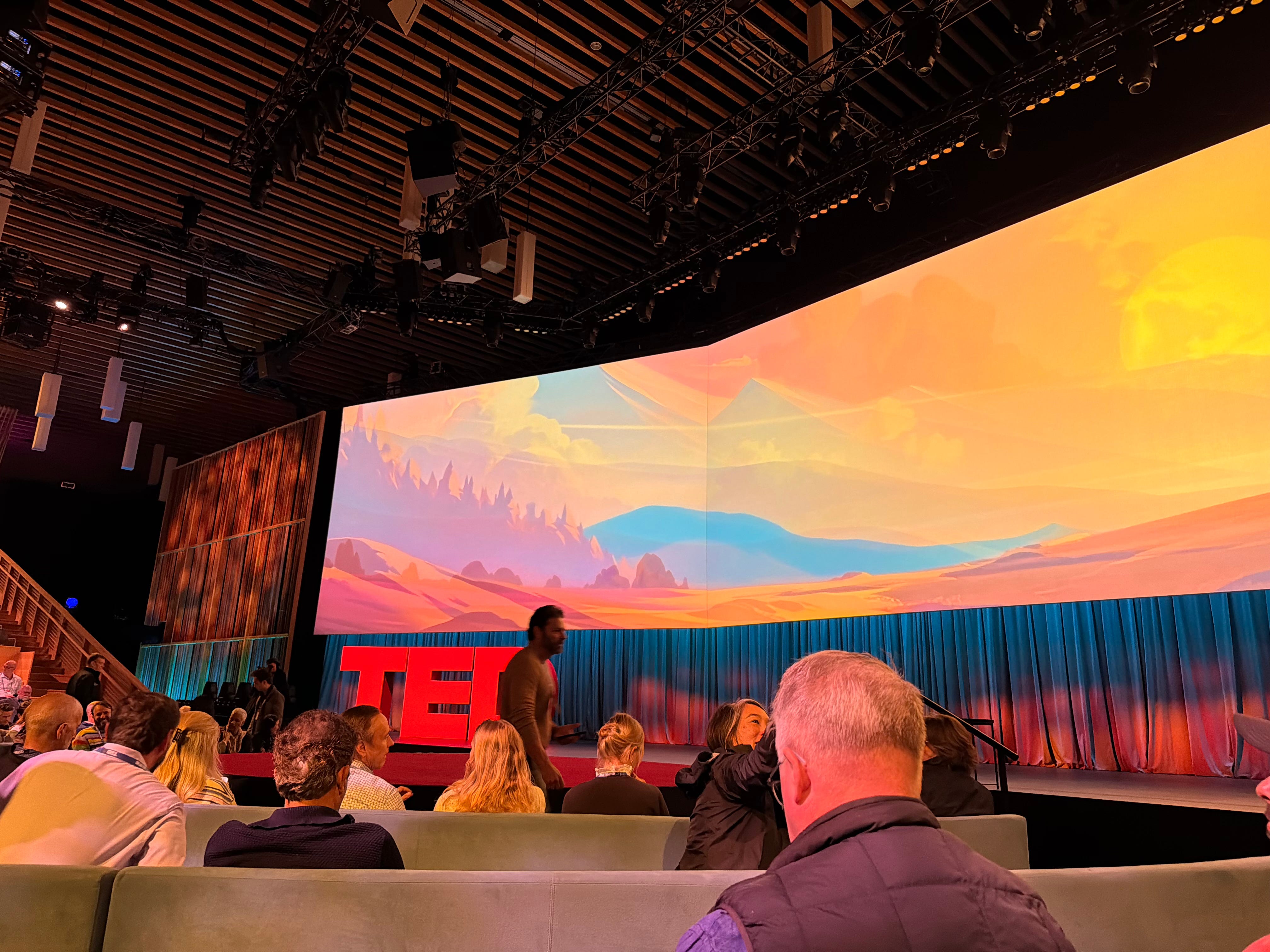
Last year, after TED, I wrote a piece called The Upload Happens Bit by Bit. It was a threshold piece for me (not least of which because I wrote from a personal point of view… which I almost never do). I tried to name the strange way change arrives before it announces itself, the way transformation embeds itself long before it explains itself. This year, stopping off in Santa Fe from Vancouver and before Boston (don’t ask), I felt something else. This time it felt less private and less romantic. A bit more like a concentrated encounter with the conditions now pressing on all of us at once.
People keep asking me some version of the same question: how was it and what mattered?
It wasn’t the “best” talk (whatever that means at TED), nor the most polished performance (believe me, those really span the spectrum). So, what actually mattered when the lanyard came off, the airport lighting returned, and the whole thing stopped feeling like a temporary city of unusually articulate people?
Turns out, what stayed with me was a pattern.
Across talks about love, childhood, the internet, work, cruelty, law, control, art and the future of AI, the same pressure kept surfacing: systems are getting better at prediction, automation, simulation and scale. Humans are getting worse at ambiguity, presence, friction, patience and reciprocity. Or perhaps more accurately, those capacities are becoming harder to practise and therefore more valuable when they do appear. That felt like the real thesis of TED 2026.
There was a bit of the machines are coming, but we know that. There was a bit of the internet is changing, but it already has. Forget the work, politics and intimacy are being reshaped by technology. We are living inside that already. We know that, too.
The most interesting theme was what starts to matter more as more of life gets smoothed, predicted, intermediated and outsourced. What becomes scarce? What becomes precious? What becomes hard enough, and human enough, to count?
So here are the nine ideas I took from the week that felt most clarifying, and why. Feel free to wildly disagree. But do so politely and intelligently. That is, after all, the point of TED.
1. Esther Perel on romantic consumerism
Esther Perel talked about “contactless reality”, “digital lag”, “ambiguous loss”, and what modern intimacy looks like when you are physically near people but increasingly cut off from touch, sensuality, mutual attention and real embodied presence.
The phrase that stayed with me most was romantic consumerism. Christ, yes, that.
Her point was not that longing is new, or that dating has suddenly become hard. The wider logic of the app economy has started to colonise how we think about people. Predictive technologies are phenomenal at removing friction. They tell us where to go, what to eat, what to watch, what route to take, which answer is fastest. That convenience does not stay in logistics and thus bleeds into expectation. We start wanting humans to behave with the clean responsiveness of systems. That is a profound change.
This makes us less tolerant of mess, uncertainty, difference, conflict, slowness, opacity, all the things that make other people other people. Love becomes less like an encounter and more like a search function. Chemistry becomes filtering. Intimacy becomes something manageable, measurable and, in the end, disposable.
Perel made a devastating point in passing: a lot of people no longer leave relationships because they are unhappy; they leave because they think they could be happier. That is consumer logic. There might be a better version two swipes away. There might be a more optimised fit. There might be somebody with fewer complications, fewer demands, fewer rough edges, fewer reminders that intimacy involves adaptation rather than curation.
The deeper cost of all this is not merely romantic disappointment but the thinning of our ability to stay in relationship with anything that does not instantly confirm us. That includes partners. It includes friends. It includes family. It includes versions of ourselves that are still becoming.
I found this part of the week especially powerful because it clarified something I suspect many people feel but struggle to articulate: modern loneliness is no longer just about being alone. It is about feeling oddly unreal in the presence of others. It is about sitting next to someone who is there and not there. It is about being trained by systems to want smoothness from people and then calling the result intimacy.
Perel’s talk kept circling the same warning: if we want technological answers to the messiness of human life, we will eventually reduce human life to something too simple to deserve the name.
2. Neil Katyal on the last human advantage
Neil Katyal had the best built-in narrative advantage: Supreme Court, Trump, tariffs, Constitutional stakes, high drama (and he won!). All of that was interesting enough. But what made the talk stick was not the legal theatre but the precision with which he located the human residue after machine prediction.
Katyal described preparing for the Trump/tariff Supreme Court case with the help of a bespoke AI system trained on decades of judicial questions and opinions. It could identify patterns, anticipate angles of attack, pressure-test arguments, and map the likely contours of the exchange before he ever stepped up to the podium. In that sense, it was an astonishing assistant.
But it did not win the case (at least not on its own). What won the case, in his telling, was live judgement. It was listening, reading the room, noticing what had not been predicted, and adjusting tone in real time. Basically, understanding not just the legal argument but the emotional shape of the question being asked. Looking at a justice and seeing worry, not simply syntax. Bridging, persuading, improvising, connecting.
That is the part that mattered. (I also gotta say, his whole point that the fact that you could predict the Supreme Court Justices due to their consistent integrity was a stroke of pure brilliance.)
We are spending a lot of time talking about what AI can now do well. Fair enough. But Katyal’s talk was a much clearer reminder that once information gets cheap, other things get expensive. Pattern recognition, breadth of knowledge and preparation used to confer an enormous edge. They still matter, but they are no longer as scarce as they were. The new premium sits elsewhere. It sits in the last mile.
Premiums are what and who is in the room. Where the pause was. What the recalibration was. The very capacity to hear what is actually being asked, rather than merely what was likely to be asked. It’s the ability to persuade another human being without reducing them to a node in a forecast.
His line that stayed with me was simple and excellent: what is the irreducibly human thing that you do? That is exactly the right question now.
For years, a lot of work has been rewarded for accumulation. (Know more. Read more. Store more. Recall more.) AI has just taken a sledgehammer to that hierarchy. The value does not disappear, but it moves. It shifts toward judgement under pressure, interpretive flexibility, relational intelligence, aesthetic choice, moral courage, timing, taste and trust.
Katyal’s talk worked because it did not turn this into a generic defence of human uniqueness but made the question itself concrete. In the most formal room imaginable, with enormous stakes and an AI model doing serious preparatory labour, the edge still came down to the oldest things. Can you listen? Can you adapt? Can you persuade? Can you connect?
That feels like a much better career question than “how do I future-proof myself?”
3. Jonathan Haidt on the cost of disembodied life
Jonathan Haidt’s talk was nominally about children. I don’t have children so, of course, my mind wandered. But, in that wandering I heard it as a broader diagnosis of adult life too.
His core claim is that humans are not merely social but ultra-social. We bond through shared meals, movement, laughter, touch, physical risk, free play, bodily co-presence. We do not simply exchange information, but regulate each other and become ourselves with and through other bodies. Turns out, that matters far beyond childhood.
Haidt’s warning is that whole generations have been pushed into a phone-based social environment during the exact years when their brains are meant to be wiring around embodied life, sustained attention and reciprocal contact. He is right to be alarmed. But the reason his talk felt bigger than a “kids and social media” argument is that the pattern no longer belongs only to children. Adults are living there too.
You can hear it in Perel’s “contactless reality”. You can hear it in the way people struggle now with boredom, silence, unstructured time and unmediated presence. You can hear it in the collapse of sustained attention. You can hear it in the cultural assumption that anything difficult, slow or socially awkward must be a design flaw rather than part of learning to live.
Haidt’s techno-scepticism is useful precisely because it is not anti-technology in the adolescent sense. It is anthropological. It begins with a harder question: what kind of creature are we, and what kinds of environments allow that creature to flourish? That is the frame I kept coming back to.
The problem is not only that devices distract us but that they encourage a vision of human life in which dependence, friction, waiting, negotiation, physical co-presence and mutual obligation start to look optional or inefficient. They are not. Those are the conditions under which trust, humour, patience, resilience and even selfhood are formed.
A culture that trains us to experience other people as interruptions, audiences, options or service surfaces will eventually run short on adults who know how to be with other adults.
Haidt was talking about what children need. The larger implication is harder: we are all being shaped by systems built by people who do not appear to think that human flourishing requires much more than convenience, stimulation and choice.
That feels less like progress than amputation.
4. Matthew Prince and Steve Huffman on what the internet is becoming
The most useful internet distinction I heard all week came from two very different talks that were really talking about the same fracture.
Matthew Prince offered the economic diagnosis: the internet, for the last thirty years, ran on a fairly legible bargain: content generated traffic, traffic generated ads or subscriptions, and that system paid journalists, researchers and publishers. It was imperfect, ugly in places, and structurally warped by click incentives, but it held. Problem is, AI answer engines are now breaking that chain.
If the user gets the answer without clicking through, traffic disappears. If traffic disappears, the old funding model for knowledge collapses with it. Prince’s formulation of this was sharp enough to stick. The future ought to reward people who “fill in the holes in the cheese” (swiss cheese was shown on the giant screen behind), people who create genuinely new knowledge, rather than those who simply repackage or inflame existing material to trigger a response.
That is not merely a media problem. I’d argue it’s is a civilisational one as it concerns what kinds of knowledge the next system rewards.
Steve Huffman gave the cultural diagnosis. Social media, he argued, is the stage. The internet at its best is the city. That distinction was brand new to me and incredibly useful.
The stage is performance. Spotlight. Audience capture. Engagement as currency. It rewards self-display, provocation and emotional escalation. It makes everybody compete for visibility. It turns the self into content and the crowd into metrics.
The city is different. The city is neighbourhoods, norms, subcultures, odd corners, shared projects, distributed participation. A city allows people to be useful, not merely visible. It allows people to become citizens rather than celebrities.
This landed with me because I have felt for years that “the internet” and “social media” were being lazily treated as synonyms when they are now functionally opposites.
One still contains the possibility of community; the other industrialised narcissism.
That sounds harsh, but I do not know how else to put it. Social media promised connection and delivered a hypertrophied economy of self-display. Influencer culture did not merely commercialise attention. It recoded public life around a constant low-level expectation of performance. You are always potentially on. Always potentially packaging yourself. Always potentially your own little media channel.
That is not what the internet once felt like. The internet once felt strange, collaborative, nerdy, communal, anonymous in productive ways, full of rabbit holes, forums, subcultures and people obsessed with building things together. It could still feel like a city. Social media, by contrast, flattened everything into a stage set.
Prince and Huffman, taken together, gave me the best synthesis of the week on this front. AI is now breaking the economics of the old web at the same time that social media has already distorted its civic and relational logic. One crisis hits the incentive structure and the other hits the soul.
Which means the question for the next phase of the internet is no longer merely “what content survives?” and also “what forms of human life do we still want it to encourage?”
Huffman’s best line was the simplest one: the stage creates celebrities; the city creates citizens. That should be taken much more seriously than it will be.
5. Bill Gurley on fascination
Bill Gurley gave the best career idea of the week, largely by replacing one bad word with a better one. Forget passion and think fascination. (Also, great endorsement for Union Square Cafe.)
That shift sounds small until you sit with it. Passion is a strangely inflated modern word. It can be passive, aesthetic, and sit comfortably beside inertia. Fascination cannot. Fascination works on you and makes you study without being told. It creates repetition, depth, obsession, range, voluntary labour and stamina. It sends you back.
His best line was that obsessive, continuous learning is not an input but instead an output. That felt exactly right.
We often talk about disciplined people as if they simply decided to become disciplined. More often, what happened is that they got caught by something. They found the subject, medium, problem or craft that kept pulling them forward. The learning looked virtuous from the outside. From the inside, it felt more like compulsion with a healthy object.
This matters in an AI economy because a lot of the lazy scripts around work are now breaking at speed. For years, the respectable advice was to find the safe lane. Get credentialled. Pick the stable path, accumulate the right resume and enter the market. That logic already looked shaky before generative systems started swallowing more of the routine, formulaic and symbolic work people had been promised would protect them.
Gurley’s counterpoint is that the people most exposed are often those who were already emotionally detached from what they do. The ones sleepwalking through a job they do not love, barely learning, optimising for security, performing competence rather than deepening craft. Those are the people for whom acceleration feels mostly threatening.
The fascinated artisan has a different relationship to the same tools. For that person, AI can become a jet pack. It speeds up exploration, shortens the path between curiosity and making, expands the amount of ground one person can cover and does not replace the fascination. It magnifies what fascination is already doing.
That felt useful beyond work as well. Fascination is one of the few good antidotes to a culture of dead ambition. It is alive, particular and resists flattening. It makes depth feel pleasurable again. It reminds you that real learning is not mainly a duty but a relationship.
If I were giving anyone career advice right now, I would trust fascination far more than prestige.
6. Keke Palmer and Heather Berlin on survival mode
Keke Palmer and Heather Berlin, in very different registers, were really talking about the same problem: what happens when survival hardens into operating system.
Keke Palmer’s talk was emotionally devastating because it made hyperfunctioning clear from the inside. She described the way survival can become so effective, so adaptive, so socially rewarded, that you no longer notice it has outlived the conditions that produced it. You stay alert and useful. And uou stay “on”. You become reliable enough to save yourself, and maybe everybody around you too. Then, years later, you realise the machinery never turned off.
Her phrase for that state was perfect: productivity without presence.
That is one of the best descriptions I have heard in a long time for a whole class of modern success. People who are competent, praised, highly functional, possibly even enviable, and yet increasingly absent from their own lives. They know how to perform, provide, produce, respond, absorb and continue. They do not necessarily know how to rest, feel, stop, receive or inhabit the life they built.
Heather Berlin widened that into a more explicit theory of control. The tighter we grip, she argued, the more anxious and rigid we become. Flourishing depends less on perfect discipline than on flexibility between restraint and release. She called it disciplined surrender. I liked that because it avoids the sentimental language that often surrounds “letting go”. She was not advocating chaos and instead describing a higher form of mastery.
Taken together, the talks exposed something I suspect many people are living right now: we have built a culture that treats control as virtue, optimisation as maturity and endless self-management as evidence of seriousness. The result is a population of adults who find it very difficult to recognise when they are no longer in danger.
That is not a small problem. It affects work, obviously. It affects health. It affects parenting. It affects love. It affects the ability to enjoy anything unproductive without guilt. It affects the ability to stop designing yourself for extraction.
Keke’s talk carried extra force because it showed how this gets inherited. Survival is not always chosen in the abstract but can passed down. It is modelled and becomes the family’s intelligence. Then one day it becomes the family’s prison.
What stayed with me from this pairing was a simple, unsettling thought: the future does not only threaten only our jobs. It also threatens our ability to know when the old survival strategy is no longer serving the life we say we want.
7. Amy Cuddy on public cruelty
Amy Cuddy’s talk struck me because it doubled down on what often gets flattened into “toxicity” or “bad vibes” with much more precision. She was talking about public cruelty as a collective system (she certainly would know).
A lot of what people describe casually as bullying is really conflict, criticism, rivalry or social tension. Cuddy’s point was narrower and more chilling: bullying is serial, escalating, audience-dependent behaviour designed to erase someone’s reputation and their ability to contribute. Less passing disagreement and more campaign.
The crucial insight for me was that bullies need an audience. That sounds obvious once you hear it, but it clarifies a great deal about contemporary public life. Cruelty scales through secondary roles: the person who laughs, the person who amplifies, the person who shares without checking, the person who remains silent, the person who treats it as spectacle and the person who thinks they are detached because they are not the original aggressor.
Platforms did not invent cruelty but they did industrialise the side roles that allow cruelty to propagate efficiently.
This felt especially important now because we still talk about public hostility as if it were mostly a problem of bad actors. It is also a problem of participation design. The machine needs more than villains. It needs incentives, spectators, carriers and ambient permission.
Cuddy’s answer was social bravery. Small acts, early acts, distributed acts. Step in sooner. Refuse the script. Notice the opening before the campaign coheres. Make it harder for humiliation to become consensus.
I liked this because it refused both naïveté and theatrical moralism. She was not asking people to become saints. She was describing a civic muscle that has visibly atrophied.
A lot of public culture now runs on the premise that attention is neutral and amplification is passive. Neither is true. Attention confers power, amplification builds legitimacy and spectacle normalises behaviour. That is why cruelty feels so much bigger than the individual people involved in it and can be termed infrastructural.
If the week had one repeated subtext, it was that systems matter. Cuddy showed that applies to cruelty, too.
8. Azusa Murakami on impermanence
Azusa Murakami gave the week its most beautiful corrective (and not gonna lie, an emotional moment).
At a conference full of power, scale, risk, automation and acceleration, she made a case for bubbles, fog, plasma, clouds, atmospheres and vanishing moments. That sounds airy until you realise the philosophical force of what she was saying. Her idea of “ephemeral tech” was a critique, not the novelty it sounds like on the surface.
Most technology is built in the image of permanence, efficiency and control. It is there to store, preserve, optimise, track, smooth, extend, scale. Murakami’s work instead stages transience: things that form, hover, shimmer, dissolve and disappear; things whose meaning cannot be separated from the fact that they do not last.
That hit me harder than I expected because it reminded me how much of value now gets described as defect if it cannot be made permanent, measurable or endlessly available. We are so used to systems that promise frictionless access and indefinite recall that we start resenting life for behaving differently.
But life behaves differently. Bodies age. Seasons turn. Children grow. Love changes form. Even the best night ends. Some dinners matter because they cannot be repeated. Some places become meaningful precisely because they are temporary. Some works of art move us because they dramatise disappearance rather than defeating it.
Murakami’s talk made me think about the strange modern desire to preserve everything and the corresponding inability to sit inside passingness without calling it loss. The older aesthetic traditions knew something we keep forgetting. Impermanence is not a design flaw. It is part of the value. (Oh, Japan!)
That applies to art… to memory… to presence. It probably applies to happiness too.
At a certain point in the week, after enough talk of systems, agents, optimisation, risk and survival, it felt almost radical to be reminded that life does not need to last forever to mean something. It only needs to be lived fully while it is here.
9. D. Scott Phoenix on holding together
Scott Phoenix gave the most grandiose talk of the week. His framing was evolutionary: AI as a major transition, mergers as the mechanism through which complexity rises (his merger being humans and AI), the future not as product cycle but as species-level shift. You do not have to buy every part of that thesis to recognise the civic warning underneath it.
His point was that major transitions fail when the parts forget the whole. Cells that cease to recognise the organism become cancer. Social groups that stop imagining themselves as part of a shared structure begin defecting from the common future. Under pressure, everybody is tempted to protect their own side, their own winners, their own enclaves, their own short-term advantage. That temptation becomes especially strong in periods of rapid technological upheaval, because the shocks never distribute evenly.
That feels like the real political risk of the next few years. The risk is what happens when rapid technological change lands in already fractured societies and accelerates abandonment, resentment and zero-sum thinking. People who lose work feel discarded and people who keep power feel entitled to retreat. Institutions wobble. and trust thins. The future stops feeling shared.
Phoenix’s answer was startlingly basic: hold together. That is not a sentimental line. The systems ahead may well be powerful enough to make abundance more possible in some domains. They may also be powerful enough to tear up labour markets, status hierarchies and political arrangements faster than our civic culture can metabolise. In that context, the fantasy that your side gets to make it through while other people are allowed to sink starts to look less like strategy and more like collective suicide.
This is where the week started to feel like one argument:
Love is being thinned by convenience.
The internet is being warped by spectacle and summary.
Work is being split between fascination and redundancy.
Survival mode is becoming identity.
Public cruelty is scaling through audiences.
Childhood is being shaped by systems that mistake stimulation for flourishing.
If all of that intensifies at once, then holding together ceases to be a moral nicety and becomes a practical requirement.
That, for me, was the real use of Phoenix’s talk. It widened the frame enough to make every smaller decision feel connected to a larger test.
The week’s real instruction
TED is always a strange mix of brilliance, vulnerability, ego, performance, sincerity, weirdness and the occasional sentence that makes you take a beat. This year, what followed me to Santa Fe was not a single slogan or one shining answer but a clearer sense of practice: protect the human capacities that do not scale neatly.
Protect the parts of life that require bodies, patience, mutuality and tolerance for mess. Stay fascinated. Learn how to listen. Stop confusing performance with participation. Do not let survival become your whole personality. Remember that community is built, not streamed. Remember that some things matter because they pass. Refuse the idea that convenience is the same thing as intimacy, or that prediction is the same thing as wisdom, or that the smoothest path is always the most human one.
Most of all, resist the fantasy that you get to make it through the next phase alone.
I did not leave TED this year feeling calmer about the future (sadly, no). But, I did leave feeling more precise about the assignment:
The systems are getting better. That part is obvious.
The real question is whether we get better at being human while they do.


