
A24 Found the Backrooms. The Internet Built Them.
The lesson is what happens when a world is built by the internet before anyone owns the movie.

By last Monday morning, Hollywood had discovered Kane Parsons. Understandable. A teenager uploads a nine-minute found-footage horror short to YouTube in January 2022. Four years later, A24 releases the feature version.
It opens to $81.4 million in North America and, by 12 June, sits just under $230 million worldwide on a reported $10 million budget. Those numbers tend to improve everyone’s interest in internet culture.
The trades carried much of the same headline: YouTube filmmakers have arrived. A useful headline, if the assignment is to describe the career move. Less useful if the assignment is to understand the market event. The lesson behind Backrooms is one of world detection, not simply talent discovery.
Parsons’ biography is remarkable. His view count is relevant. His age is irresistible. None of those details explains why Backrooms was legible at scale the moment A24 put a film in theatres. The more important fact sits underneath the creator story: before the movie existed, Backrooms had already behaved like a world.
People could explain it to strangers. They could extend it. They could fight over canon. They could rebuild it in games. They could make derivative found-footage. They could sort it into levels, entities, rules and survival logics. They could recognise a valid version without needing one central authority to bless it.
This is not the same thing as a viral video. A viral video creates awareness and a world creates literacy.
Hollywood knows how to buy awareness. It is less fluent in literacy because literacy tends to form outside campaign architecture, in places nobody can properly schedule: subreddits, wikis, Discords, YouTube rabbit holes, game servers, comment threads, lore arguments, teenage bedrooms, the soft derangement of people voluntarily maintaining taxonomies for imaginary spaces.
How it all began
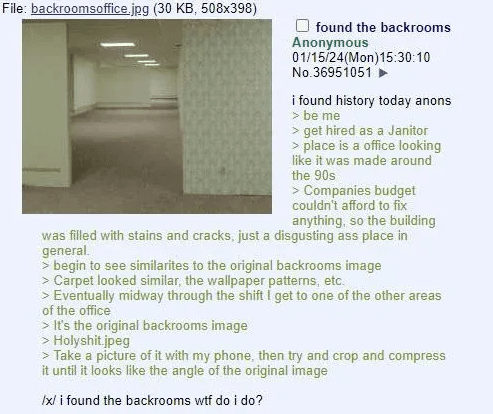
The Backrooms began in May 2019 as an anonymous 4chan image and caption about “no-clipping” out of reality into an endless yellow labyrinth.
![The origin of the backrooms was a post on 4chan [2019] : r/backrooms](https://substackcdn.com/image/fetch/$s_!GxLS!,f_auto,q_auto:good,fl_progressive:steep/https%3A%2F%2Fsubstack-post-media.s3.amazonaws.com%2Fpublic%2Fimages%2F5c260e0d-85a3-4c45-a706-66bb19912b38_1280x1280.jpeg "The origin of the backrooms was a post on 4chan [2019] : r/backrooms")
The seed was tiny. That helped. There was no protagonist to protect, no ending to preserve, no authorial estate managing the sacredness of the carpet. The original post supplied a simple grammar: fall out of reality, enter wrong space, survive the fluorescent nowhere. Enough structure to recognise the world; enough blankness to keep adding to it.
Stories need continuation. Settings invite entry.
Within days, there was a subreddit.
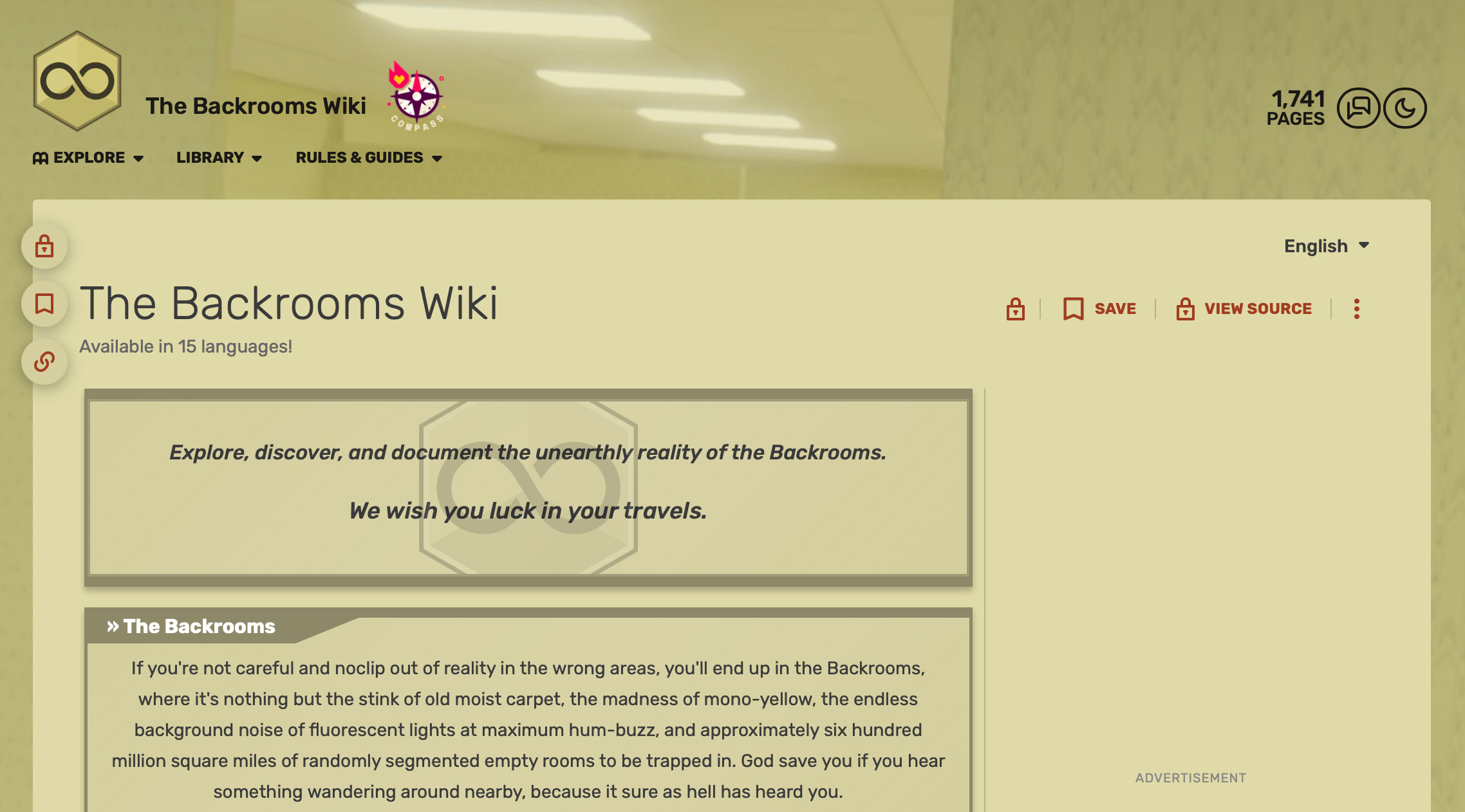
By 2020, there was a collaborative Backrooms wiki, open to contributors and licensed under Creative Commons.
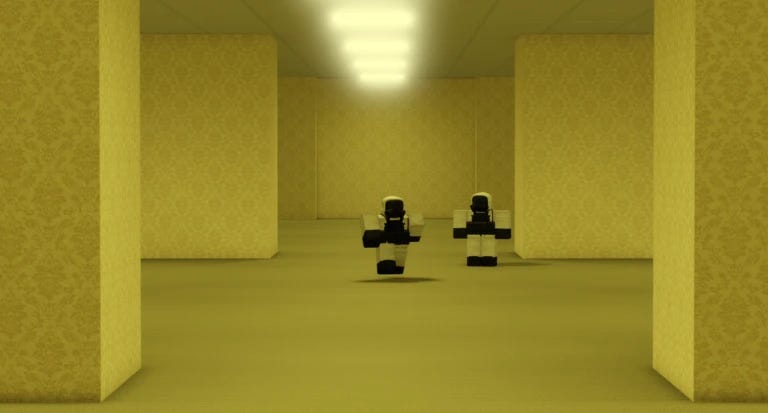
Over time, the world acquired levels, entities, objects, factions, maps, games, found-footage spin-offs, Roblox and Minecraft recreations, Discord routing, competing canons and all the usual signs of a fandom that has turned a mood into infrastructure.
This is not about YouTube-to-Hollywood
Backrooms did not arrive in Hollywood as a finished story with an audience attached. Instead, it arrived as a world whose audience had already learned to exist within it.
That matters for development. Traditional IP starts from a centre: a book, comic, game, film, rights-holder, character, author, franchise bible. The internet then interprets it. Marvel begins centrally and gets atomised afterwards. Dune begins centrally and gets atomised afterwards. Five Nights at Freddy’s sits closer to this territory, but still begins with Scott Cawthon’s authored and owned game series. The lore spreads through interpretation, but the source text remains load-bearing.
The Backrooms’ 2019 post remained historically important and quickly became creatively insufficient. The active unit became the compatible contribution: a level, a video, a game, a theory, a variant, a room. SCP1 is the sharper structural comparison: collaborative fiction, governance, canon plurality, procedural extension. The Backrooms carried that logic into a more immediately cinematic spatial form.
Kane Parsons supplied the missing conversion step.
Backrooms is a Rendering
Kane did not merely acquire an audience, but rendered the branch that could extend to cinema.
Render is the right word because it avoids a lot of sloppy thinking. A render is a selected view of a larger system. It is framed, lit, finite and usable. Parsons’ 2022 short took a loose internet setting and gave it cinematic discipline: camera movement, timing, restraint, spatial logic, dread with a frame around it. He made the Backrooms feel less like lore and more like a film language.
A24 then rendered that rendered branch at industrial scale: stars, production design, distribution, marketing, theatrical scarcity, the compression of many years of distributed meaning into one official object people could buy a ticket for.
That is the mechanism.
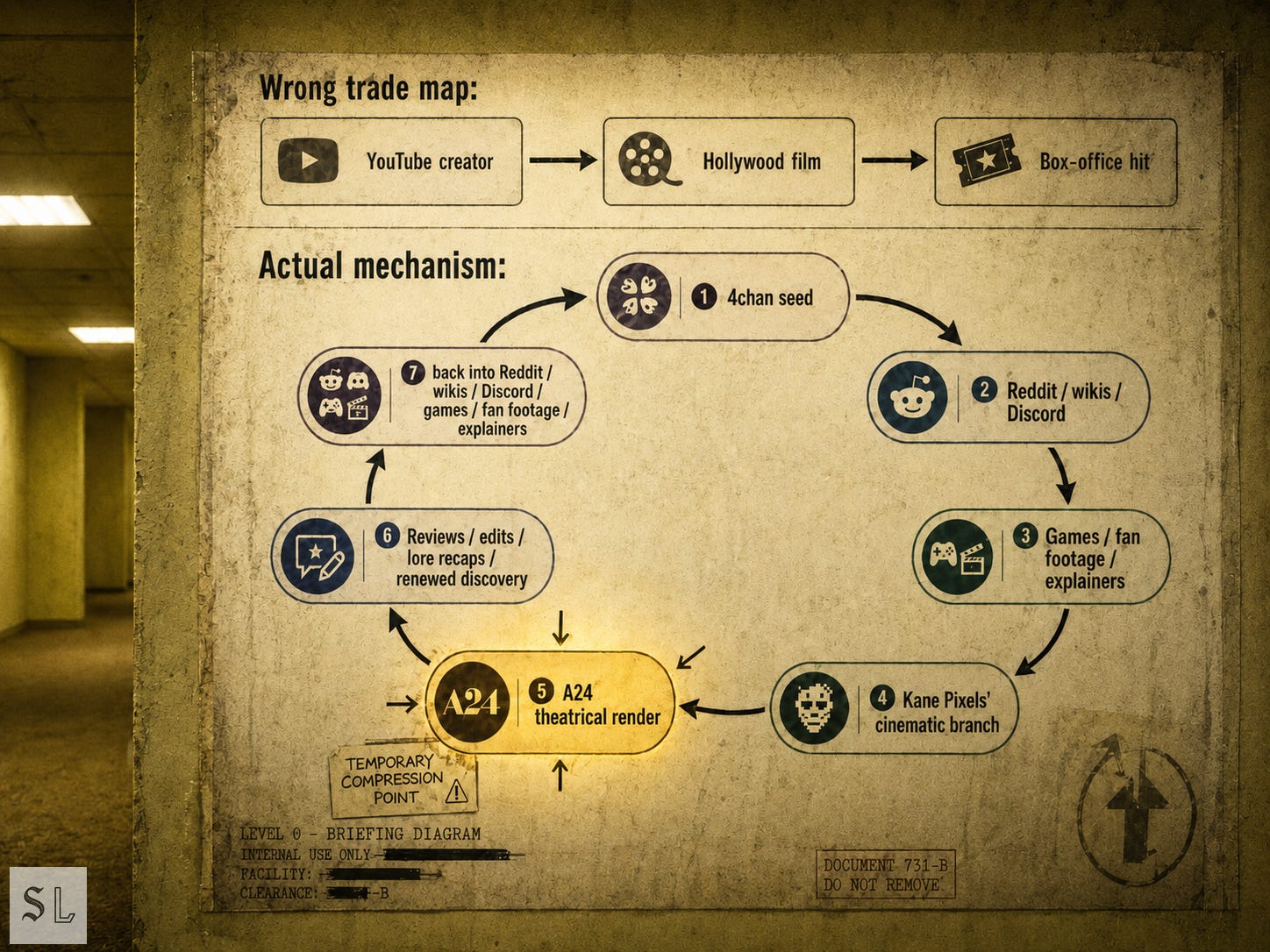
No final box. The film sits inside the loop, not at the end of it.
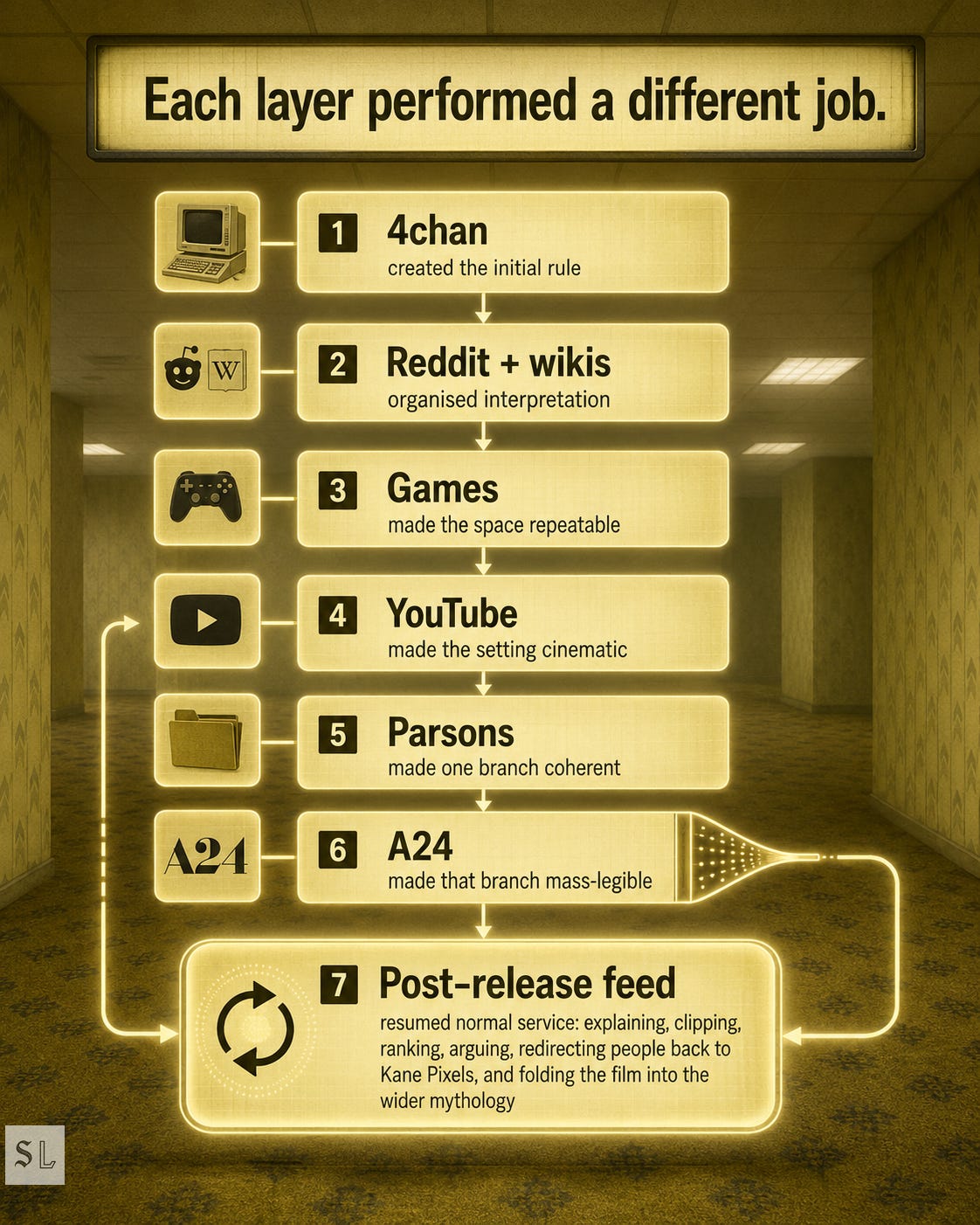
Post-release atomisation itself proves very little. Everything gets atomised now. A superhero film becomes ending explainers. A prestige film becomes Letterboxd prompts. A trailer becomes frame-by-frame content before anyone has had breakfast. The distinctive feature of Backrooms is its sequence. The atomisation existed before cinema. The movie concentrated it.
That concentration is the commercial move.
For a short period, a polycentric setting holds one dominant shape. A multi-canon world becomes a release date. A fandom grammar becomes production design. A distributed audience becomes opening weekend. Then the shape loosens again. The Wikidot continues. The subreddit continues. The games continue. The arguments over proper Backrooms lore continue. A24 has a hit; the larger setting keeps forking as if no film could possibly settle the matter.
Good. That behaviour is the point.
“Enclosure” sounds attractive here and fails on contact. A24 did not fence the Backrooms. It made one path through them legible enough for the marketplace. Specific works are owned. The setting-level culture remains polycentric. That distinction makes the case more interesting because the model depends on the world staying open enough to keep generating activity around the official render.
The obvious counterargument strengthens the analysis. If these owner-light settings are so valuable, why has SCP not produced a comparable theatrical hit? Why did Slender Man reach cinemas without becoming this kind of live industrial model? Why do most creepypastas remain creepypastas?
Because the setting lowers risk without removing difficulty. A pre-existing internet world gives Hollywood a head start, but it does not make the film easy. In this case, Backrooms lowers risk because people already know the basic idea, the mood is already proven, there is existing lore, fandom, games, videos and canon debate and audiences already understand what “feels like Backrooms”.
But it does not remove difficulty because someone still has to choose the right version of the world, turn loose lore into a controlled film, make it emotionally and visually compelling, avoid flattening what made it interesting and have taste, restraint and cinematic skill.
The world gives you a head start, not a finished film. A world can supply mood, grammar, audience literacy and public proof of demand. It cannot supply taste. It cannot supply a director. It cannot decide which branch deserves a camera. Parsons is not a decorative biographical detail; he is the bottleneck. The internet can generate endless expandable settings. Very few acquire a renderer capable of turning one into a controlled two-hour object. That is the lesson Hollywood will be tempted to flatten.
The wrong search begins with follower counts (dear god, I can’t say this enough times). The better search begins with behaviours.
Can people add to the world without breaking it?
Can they play inside it?
Can they explain it quickly?
Can they argue about canon without destroying interest?
Can it move from image to video to game to wiki to short-form without losing recognisability?
Can one strong authorial branch become official for a while without killing the rest?
Those are development signals. They are harder to measure than views and more useful than vibes. They show audience formation rather than audience size.
An inversion of the feed
Hollywood usually treats the feed as marketing layer: a place where attention is harvested after the real thing exists. Backrooms shows a different order. The feed performed part of development long before a studio campaign began. It tested the world, educated the audience, surfaced the branch and produced years of behavioural evidence around the setting.
Nobody involved had to call that development (that would have ruined the mood).
It looked like fandom because it was fandom. It looked like play because it was play. It looked like lore because it was lore. Its commercial value came later, once someone recognised that the audience had already done a significant part of the work studios normally pay to manufacture: learning the world.
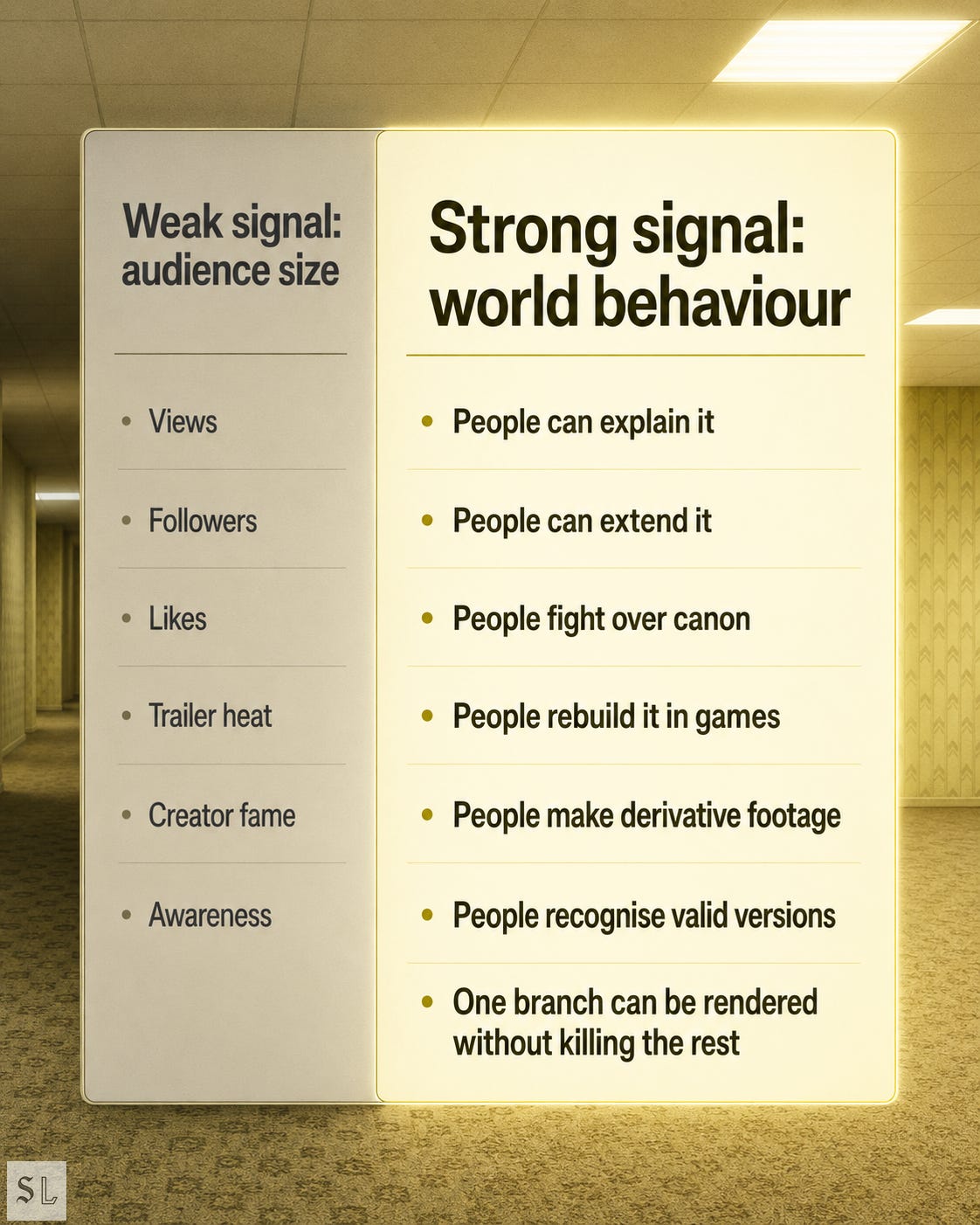
“YouTube filmmakers have arrived” keeps the analysis at the level of talent discovery. The more useful analysis sits at the level of world detection. Hollywood found a creator, yes. More importantly, it found a setting the internet had already made usable.
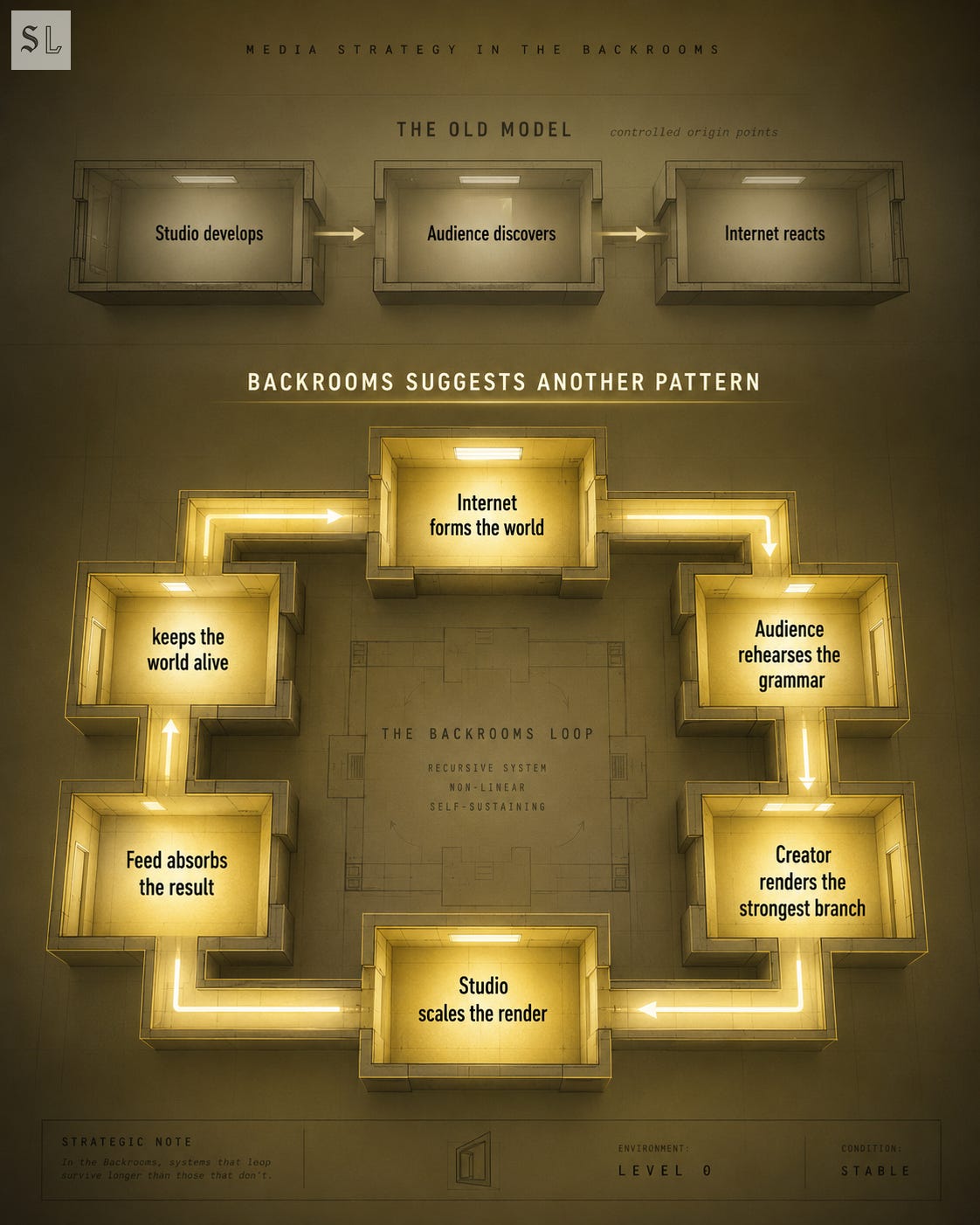
The order matters because it changes what counts as IP
Ownership still matters, obviously. Rights matter. Authorship matters. Distribution matters. But legibility may now matter just as much: does a culture already know how to recognise and use this world?
The next Backrooms will not announce itself as the next Backrooms. By the time it does, it will already be too late. It will look too minor, too ugly, too ambient, too overbuilt by strangers, too online to qualify as a serious development opportunity. Then the behaviours will accumulate. People will explain it, extend it, play it, fight over it, remix it, and teach one another the grammar before any studio realises there is a grammar to buy.
A follower count was the least interesting number in the room. The feed had already built the franchise.
SCP means the SCP Foundation / SCP Wiki: a long-running collaborative internet fiction project where users write entries about anomalous objects, creatures, places and phenomena, usually in the style of institutional case files.