
TV Is a Behaviour: What Netflix’s Podcast Bet Reveals About the Future of Television
The bigger lesson in Netflix podcasts is not whether audio can work on TV, but how the living room is starting to reward behavioural fit over legacy format.

👋🏼 Greetings from LAX after a (very) busy week in LA and before heading to Vancouver for a (very) busy week at TED. If you’ll be at TED next week, say 👋🏼 back.
People are asking whether Netflix can make podcasts work. Fair question. It’s just smaller than the important one hiding inside the data. What the early numbers really illuminate is not about podcasting at all, but really a story about television.
I have found myself saying for a while (repeatedly, sorry about that): film is a format and TV is a behaviour. Film describes an object. TV describes a behaviour: routine, focus, repeat visits, a kind of ambient intimacy, the sense that something intentionally belongs on one’s primary screen. That distinction matters more now because the television set no longer belongs to one industrial category. YouTube has been nudging that fact into the open for years. Netflix’s podcast experiment gives us another very clean case study.
The headline numbers are encouraging but limited. Samba estimates that 13% of US Netflix-viewing households watched at least one cumulative minute of a podcast in Q1 (first issue: 1 min is a very low bar…). Useful directional signal, not a final verdict. Samba is measuring US smart TVs, not mobile, despite Netflix saying podcasts over-index on mobile (second major issue). So let’s just say the initial data is illustrative, not the market trajectory.
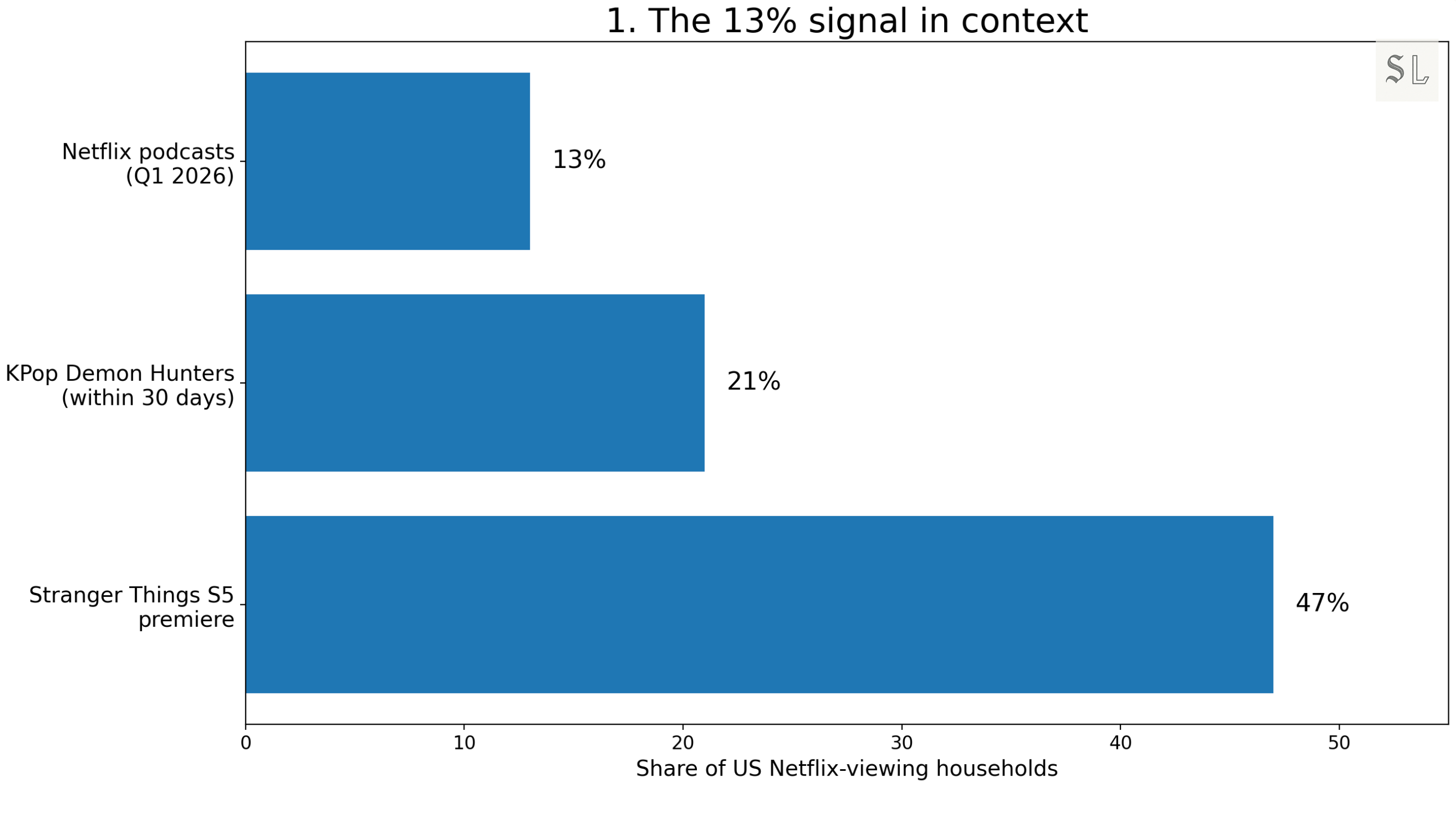
Even so, the shape of the data is revealing. Netflix launched roughly 46 podcast titles in Q1, around 39 licensed and 7 Originals. Originals make up only about 15% of the catalogue, yet still rank second by publisher on a per-title basis. So this is not just a dumping ground for video versions of audio shows. The platform is already surfacing a particular kind of fit.
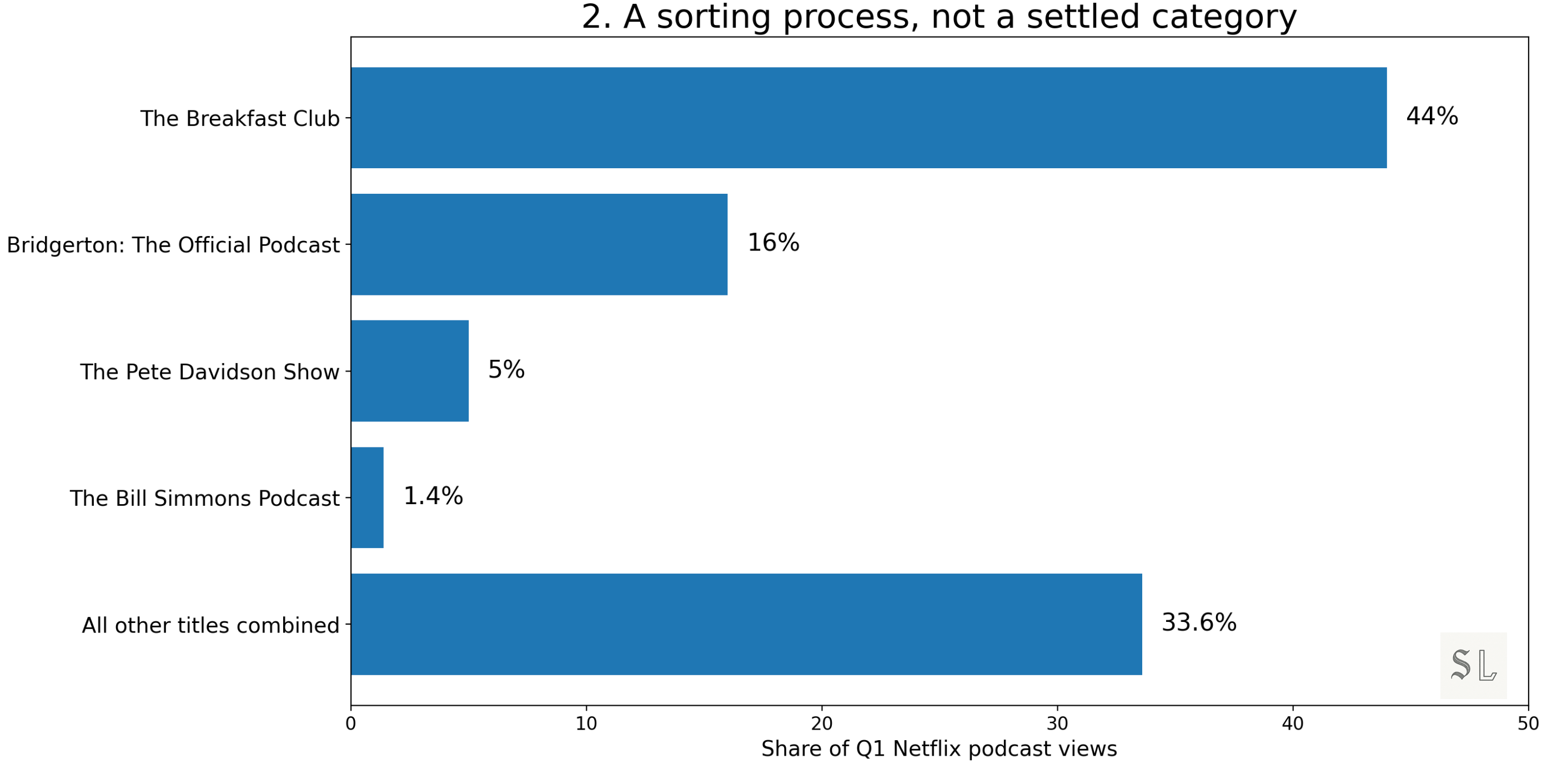
The category is also brutally top-heavy. The Breakfast Club accounts for more than 40% of Netflix podcast views in Samba’s analysis, and Bloomberg reports 44%. It led the number two title by roughly 3x. Bridgerton: The Official Podcast took 16% of views. By the time you get to The Bill Simmons Podcast at number eight, the share is 1.4%. This looks more like a sorting process than a settled category looks like.
And that is the point. The most useful finding in the entire data set is the mismatch with Podscribe. Samba compared Netflix rank with Podscribe’s rank across audio downloads and YouTube views and found little to no correlation. In really simple terms, Netflix is not simply inheriting the podcast charts. Podcasts in the living room are making their own choices, perhaps creating a new sub-category of podcasts in the process.
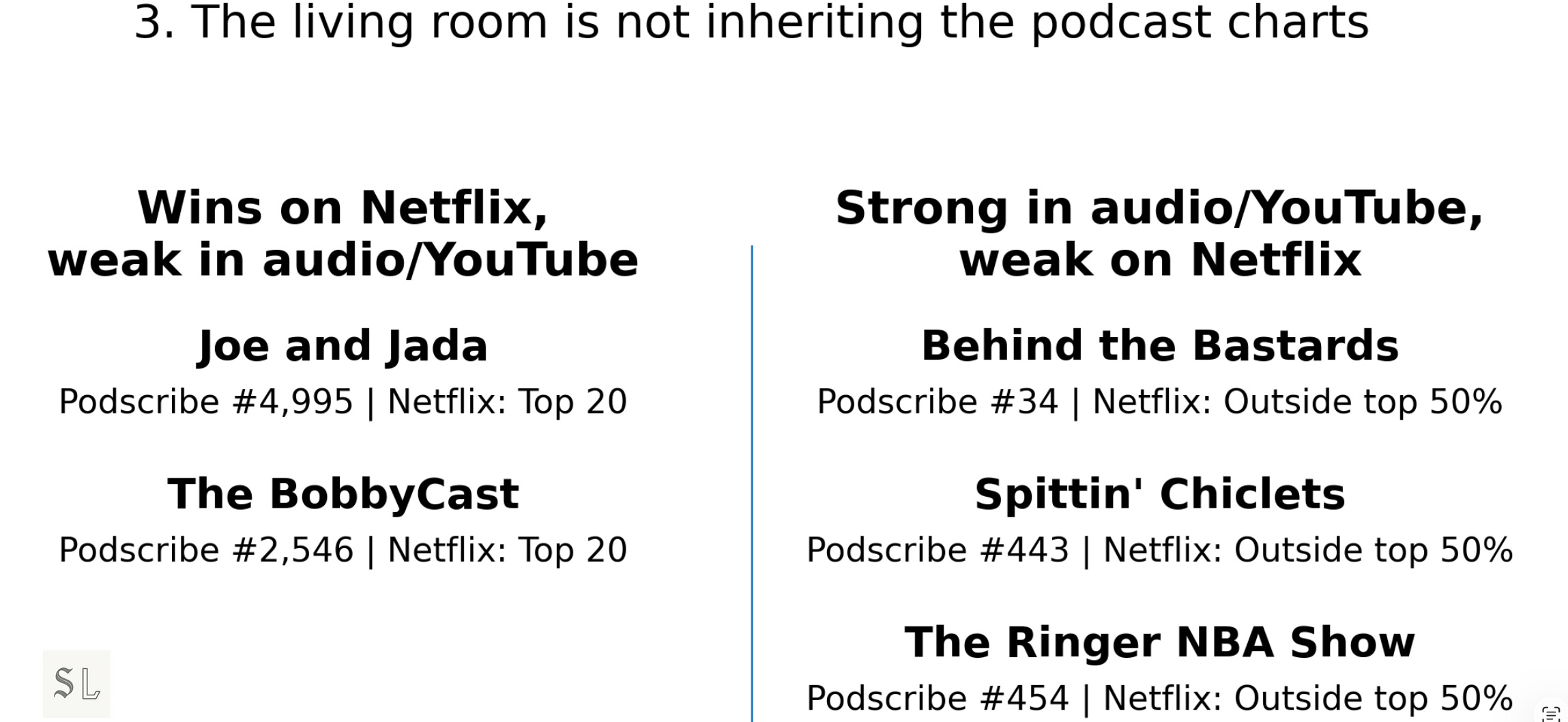
What seems to matter on Netflix is not “the best podcasts” in the abstract. The early winners look more like shows that already lean into a big screen: celebrity chemistry, fandom adjacency, culturally specific community shows, programmes where face, presence and cadence matter as much as the audio. The weaker fits are telling too. Narrative storytelling, sports commentary and classic on-the-go formats still seem more natural in headphones than next to the remote.
The Breakfast Club is the clearest initial proof point. It brings exactly the attributes the living room tends to favour: recognisable personalities, regular cadence, cultural fluency, visual presence and an audience relationship built over time. Nearly half of viewers watched within 48 hours of release. Forty-four per cent of viewing happened in daytime or primetime rather than early morning, despite the show’s radio roots. Black audiences over-indexed by more than 2x, 68% of Black viewers watched two or more episodes, and average viewing time for Black audiences reached 22 minutes per episode. Again, this seems less casual sampling and more like habit finding a new screen.
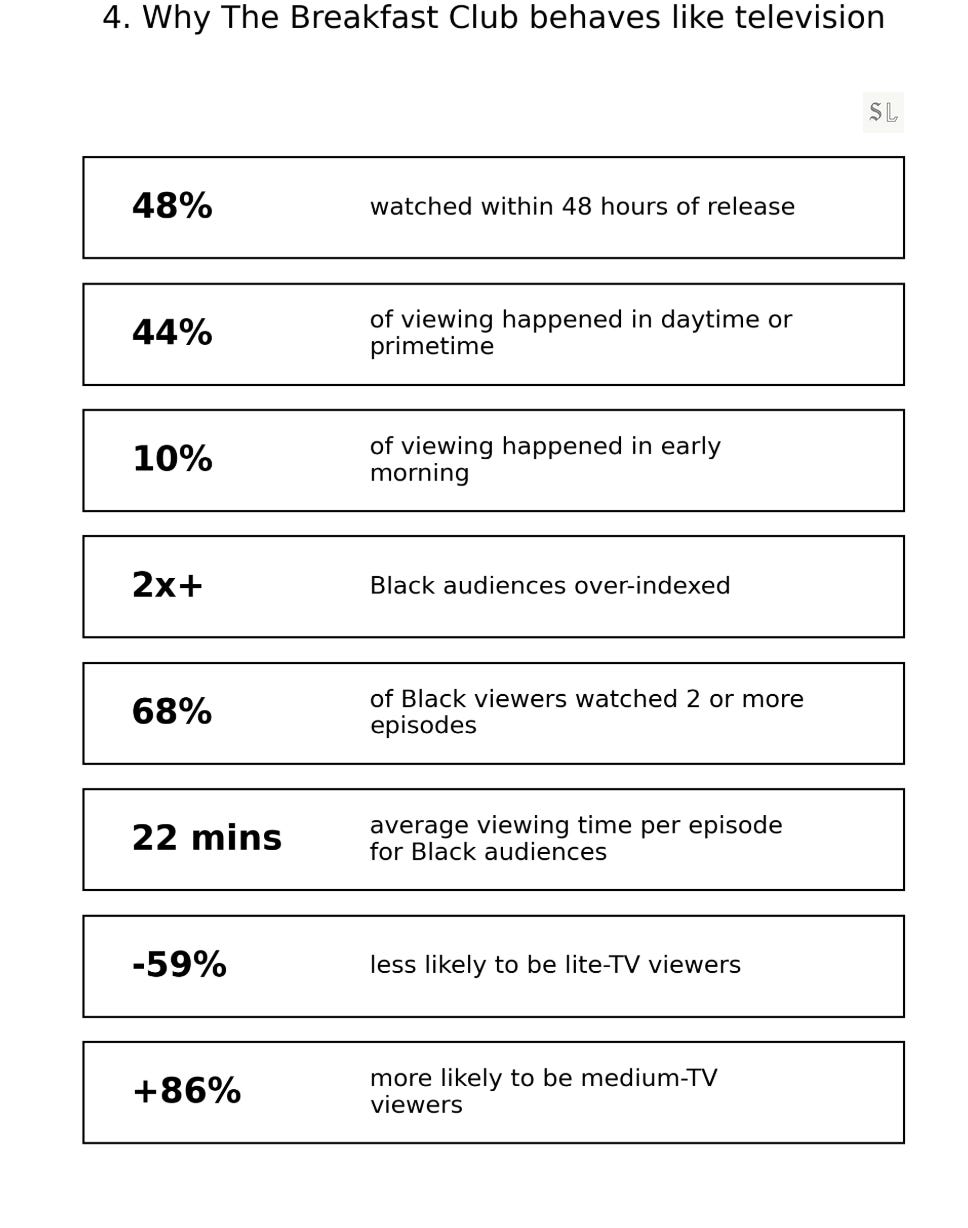
This also starts to alter the commercial logic. Podcasting has often been sold as additive to TV because podcast listeners under-index on traditional television. But households watching The Breakfast Club on Netflix were 59% less likely to be lite-TV viewers and 86% more likely to be medium-TV viewers than the average US household. Once a show moves into the living room, it can stop being audio inventory and become more like premium streaming video or high-frequency shoulder content built around talent and IP.
That matters well beyond Netflix. For platforms, it changes what deserves shelf space. For creators, it clarifies which shows travel from pocket to sofa. For IP owners, it suggests companion programming can do more than market a franchise when it actually belongs in the room. For brands, it complicates the old distinction between audio reach and television attention. Those categories are starting to leak into each other. Just like every other category leaking into each other.
I would not overstate any of this. The sample is partial, the category is early, and one show still dominates the story. But the useful lesson is already here and worth thinking about: the question is no longer whether something is “TV” in the old catalogue sense. The question is whether it can earn television behaviour: focus, routine, repeat use, presence, and permission to exist on the primary screen in the house. Some podcasts clearly can. Which means the interesting thing Netflix may be sorting is not podcasting at all, but what counts as television now.